How I launched 40 quests resulting in 111K activations
In Web3, attention is easy to buy. Adoption is not.
Quests close that gap. They turn “I heard about this protocol” into a guided set of actions that prove usage, validate completion, and reward the right behavior.
Towards the end of last year, I launched 40+ quests across major platforms, resulting in 111K+ unique activations. The work was built as a repeatable system, where each quest is treated like a mini product launch.
What Are Quests - What it is
On and Off-chain
Why Quests Matter - To who and why it matters
Users, Projects, Quest Platforms, and Me
How I build quests
Project Discovery - Strong fit shortlist - Meaningful first use
Project Enrichment - Full research pack - Test like a user
Referral Setup - Trackable referral link - Verify with second wallet
Functional Testing - Confirmed working flow - Minimum viable transaction
Quest Doc Build - Clear card-by-card steps - Zero ambiguity wording
Preview Image - Consistent quest creative - Clean template system
Builder Implementation - Verified tasks live - Chain and contract checks
Review and Approval - Quest goes live - Fast feedback loop
Promotion - Distribution in community - High-intent visibility
Many resources were generated for the purposes of:
Project Discovery - Find projects to create quests
Quest Enrichment - Research the project and find links and information
Quest Building - Setup the first draft, use the quest builder, and get the quest reviewed
Quest Promotion - After publishing the quest, promoting the quest for user adoption
All Quest Resources -
A quest is an interactive onboarding and growth campaign that blends on-chain actions, offchain actions, and verification with rewards.
Think of it as a structured user journey.
Instead of asking someone to “go try the product,” you give them a clear path to the first meaningful outcome.
Quest Journey Overview:
A user opens the quest
User completes actions
On-chain - Swap, Deposit, Provide liquidity, Stake, Lend, Borrow, Bridge, Mint, Vote, etc
Example - Layer3
Off-chain - Open Link, (Go to website, Read docs, Watch a tutorial, etc), Complete a quiz, follow on social media, join community (discord or telegram), Engage with campaign posts, Contribute on GitHub, etc
Rewards unlock upon completion
There are many different quest platforms, here are just a few:
Quests reduce confusion and increase confidence.
Learn by doing - Better appreciate of crypto via exposure to new projects
Faster first success - a guided on-chain experience
Less fear of mistakes - Genuine projects with real rewards
Progress feels measurable - Each quest is gamified
Reputation becomes portable - Show your score and get into the community
Quests are a performance channel built around outcomes.
Instead of optimizing for impressions, teams can optimize for verifiable actions: first swap, first deposit, first vote, first bridge.
Higher intent users - Real users using real liquidity
Faster time to activation - Quest promotions = Fast turnaround time
Guided “aha” moments - Provide genuine experiences and favorite tools
Cleaner attribution signals - Referral URLs, UTM links, and traffic spikes for quests
Better lifecycle sequencing - Create campaigns which have increased on-chain activity
Community flywheel effects - Introduce users to more of your project, community, and future roadmap
Platforms provide the rails that make quests scalable.
They standardize task formats, verification flows, reward delivery, and discovery. That infrastructure is why quests can function as a reliable growth motion, not just a one-off campaign.
Task templates at scale - Quest volume = greater predictability and more incentives
Verification tooling - Consistently validate users and activities
Reward distribution systems - Create incentives for more activity and increase overall growth
Leaderboards and sprints - Competition and gamification elements
Analytics and admin workflows - Incredible granular tracking and testing
My motivation is simple: quests are where growth, product, and community meet.
I like work that is measurable, user-first, and hard to fake. Building quests forces precision: every link, instruction, proof, and reward mechanic has to hold up in the real world.
Adoption focused writing - Practice promotion and “what’s in it for me” writing
Funnel and UX thinking - Greater appreciation for better user experience and product-led growth
Proof based growth loops - Clear demonstrations of real-world gamification and user triggers resulting in better conversions
High standards testing - Set a high bar with consistency
Clean execution under constraints - Go from manual, To somewhat automation, to 90% automated.
Quest Activations on Layer3:
Project Discovery Channels:
I source projects where quests can create meaningful first use, not just clicks.
You need to know what you’re looking for, where to find it, and what “good” looks like.
Search Terms:
Search Terms -
Discovery by Channel
Airdrop and campaign trackers -
Recently funded lists -
Accelerator cohorts -
Pitch competition lists -
Crypto Events -
Hackathon Directories -
Funding Feeds -
Quest Platforms -
Telegram Airdrop -
X Airdrop Alerts -
Selection and Prioritization Criteria:
EVM or Solana Ecosystem - More familiarity and greater adoption
Functionality - Product works and on-chain activity exists
Doxxed Founders - Real team with real profiles (Less likely a scam or rug)
Funding - Did this project get funding - Does the project momentum
External Audit - Real web audits done by reputable companies
X Activity - Does this project have genuine and consistent posts on or/ Discord
Referral Link - Does the this platform allow me to create a referral link and can get credit for referring users
Smart Contract - Is the smart contract legit - Use de.fi or arkhamintelligence
Transactions Volume - Are there many transactions (Daily, Weekly, Monthly) associated with the smart contract
Collection:
Fast Collection - for further review -
Before writing a single task, I map the protocol like a marketer and test it like a user.
Research checklist:
Web URLs
Homepage and product pages
Documentation, litepaper, whitepaper
Blog, Medium, and News sections
Application / Platform
Core App URL
Referral
On-Chain Actions
Social Media and Community
X / Twitter
Discord
Telegram
Quest, Airdrop, or Campaign Specific Posts
Resources:
Deep Research LLM - Perplexity,
Prompt - Quest Project Research -
Quest Template - Google Doc -
Quest Enrichment - Add Research to Sheet -
Exampe: Using Perplexity to enrich projects
If a project has a referral mechanism, I generate a tracking link early.
Referral links give me a chance to earn something on top of the quest.
Referral links create attribution and allow me to track my incentive structure for sustained promotion.
Referral best practices:
Complete Registration
Find the Referral Link Generator
Create / Get Unique Referral LINK
Test Link (Sign Up with a secondary wallet)
Example - Velvet Trade - https://dapp.velvet.capital/Referral/1
Testing is where good quests stand out.
I complete every step exactly as a new user would.
Testing standards:
What actions can be done)
Does it work (On-Chain)?
Is it easy (Beginner - Medium)?
What is the minimum viable transaction
Confirm positive result (Points or rewards earned)
Clear time estimates per step
Overview:
Write a few short sentences describing how this was done.
In a Google Doc, Build your quest with the following:
Resources:
Project Links and Raw Data -
LLM + Deep Research / Internet Access
Prompt - Quest Creation
Quest Template - Google Doc -
Wordsmithing, Adjustments, and Review:
Protocol Metrics and Details
Instructions
Links
Cards
Most of the time, the LLM (Perplexity), found the web URLs and most of Social Media and community links.
Example
Collect your assets and use a simple template.
Find the logo, make a background, and add it to the template in Photopea.
Tools:
X / Twitter - Find Logo
Photopea - Use .PSD template
LLM + Prompt - Create background photo
Assets:
Project Logo - Usually found on X / Twitter Profile
Background - Generate a background (Landscape) using LLM
Template - .Psd Template
Photopea - Add Layer Mask over template + Add background
Example - Bless PNG - Bless - quest logo psd.psd
Finally, export and upload to the quest platform.
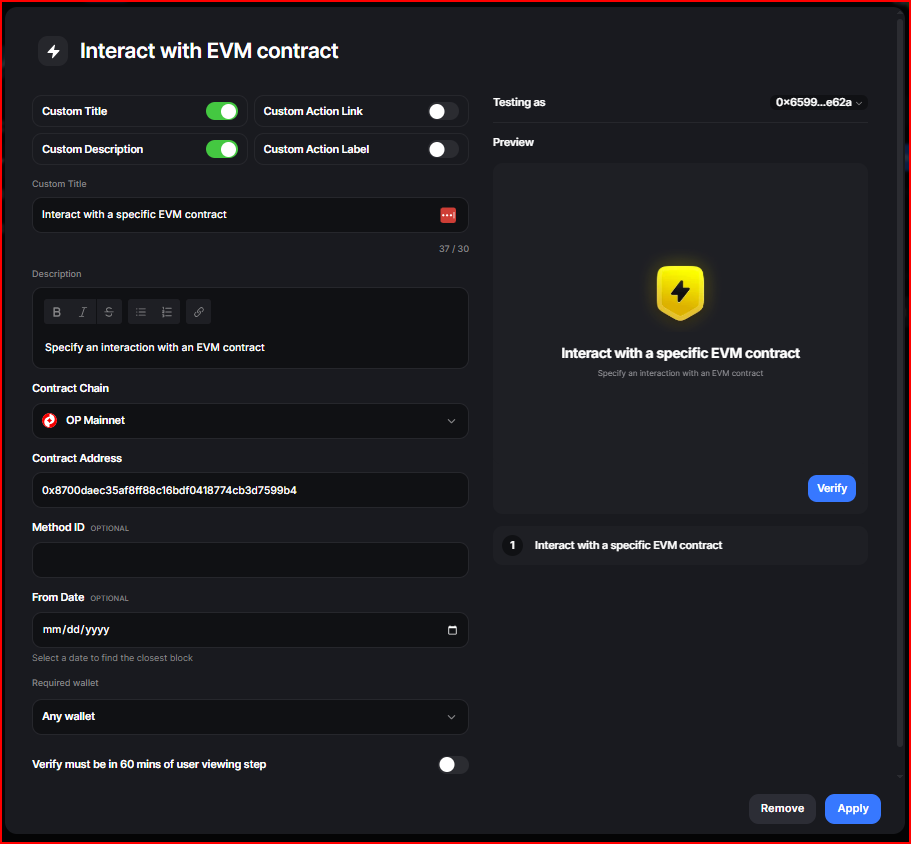
Most quests were implemented in the platform’s builder, especially Layer3.
Layer3 has excellent documentation and support in the builder activation documentation.
Builder focus:
Core Quest Details - Quest name, description and URL structure
Chain Selection - Solana vs EVM
Card sequencing - Info cards:
About the Project / Protocol
About the quest
Potential rewards
Onchain Activity
Chain Selection
Smart contract Identification
Testing / Transaction Validation
Validation Details - Time, Minimum Amount, Specific Token, etc
Off-chain activity
Open Link (View Website, Video, Blog, Post)
Join Community
Like, Comment, and Retweet
Follow on X
Resources
Quest Draft - Google Doc (Specific to this quest)
Preview Image - PNG with Company Logo and background
Links - Referral, SoMe, Community, Documentation, Etc
Screenshots - Steps, Actions, Platform, etc
Review Checklist
Flow - Does it make sense and work
Link review - Referral link, SoMe Or Community
Wordsmithing and format adjustments
The goal was always the same: keep users moving, keep proof clean.
After completion of the quest inside of the builder, I submit it inside of the platform.
Sometimes I would publish multiple quests in the same day.
Using a telegram group, I write to a few moderators and ask for feedback.
The moderators would review the quest and sometimes provide feedback.
Feedback would almost always be minor and the quest would go live within 1-2 business days.
After the quest was published on layer3, I would amplify the reach of the quest by doing the following:
Post the Quest on my own X
Tag the Project
DM the Channel and Team (if possible)
Join the Community (Discord or Telegram)
Post in a general channel asking if people from the community had seen it yet
Create a ticket and ask the moderators to post about it.
Resources
Prompt - Quest Promotion -
Prompt - Quest Promotion -
On-occasion, I’ll check back on the project to see
How my referral earnings are going
Project developments
The 111K+ activations did not come from guesswork.
They came from a launch system designed to remove friction, protect proof quality, and make completion feel obvious.
In many cases I would receive points every time someone clicked through a quest link and signed up.
Additionally, Layer3 gave me kickbacks for publishing quests.
Sometimes the projects might give me a small kickback for my trouble.
Layer3 had a very active community and anyone could publish quests
39 of my quests went live on Layer3
More than 111,000 activations in total
2500 - 3500 activations per quest
Generated $32K in Rewards
Project Discovery - Strong fit shortlist - Meaningful first use
Project Enrichment - Full research pack - Test like a user
Referral Setup - Trackable referral link - Verify with second wallet
Functional Testing - Confirmed working flow - Minimum viable transaction
Quest Doc Build - Clear card-by-card steps - Zero ambiguity wording
Preview Image - Consistent quest creative - Clean template system
Builder Implementation - Verified tasks live - Chain and contract checks
Review and Approval - Quest goes live - Fast feedback loop
Promotion - Distribution in community - High-intent visibility
What clients and teams get from this approach
Faster onboarding - First to value
Stronger verification - Fewer farmers
Better completion - Clarity
Campaigns built - Real usage
Launch process - Scalable
If you want onboarding that feels crisp, measurable, and genuinely useful to users, quests are one of the best tools Web3 has.
The difference is execution. That’s the part I’ve systematized.